

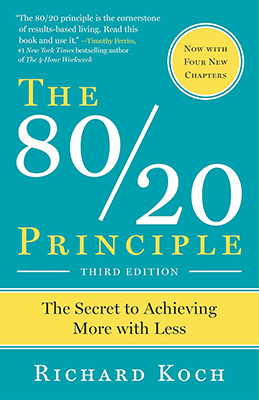
Quiz: The 80/20 Principle by Richard Koch
1. What is the central idea of the 80/20 Principle?
A) 80% of people are naturally more productive than 20%
B) You must work 80 hours to achieve 20% growth
C) 80% of results come from 20% of efforts
D) 80% of resources should be spent on marketing
2. According to Koch, how can businesses apply the 80/20 Principle effectively?
A) By expanding product lines rapidly
B) By reducing staff and increasing automation
C) By identifying the most profitable customers or products and focusing on them
D) By outsourcing all non-essential functions
3. Which of the following best illustrates the 80/20 Principle in personal productivity?
A) Completing all tasks in the order received
B) Identifying and focusing on the few tasks that generate the greatest impact
C) Responding to every email immediately
D) Working longer hours to cover more ground
4. How does Koch suggest people can improve their quality of life using the 80/20 Principle?
A) By minimizing leisure time
B) By focusing on the small number of activities that bring the most happiness
C) By multitasking more effectively
D) By following rigid daily routines
5. What is a common misconception about the 80/20 Principle, according to the book?
A) That it only applies to large corporations
B) That it is a fixed law rather than a flexible observation
C) That it focuses on inequality
D) That it guarantees instant success
Answer Key & Explanations
1. C) 80% of results come from 20% of efforts
Explanation: This is the core idea of the 80/20 Principle (also known as the Pareto Principle): a small portion of causes, inputs, or efforts usually lead to the majority of results.
2. C) By identifying the most profitable customers or products and focusing on them
Explanation: Koch advises businesses to double down on what works—focusing resources on the 20% that delivers the highest returns rather than spreading efforts evenly.
3. B) Identifying and focusing on the few tasks that generate the greatest impact
Explanation: The 80/20 Principle helps individuals become more productive by concentrating on high-impact activities instead of being busy with low-value work.
4. B) By focusing on the small number of activities that bring the most happiness
Explanation: Koch extends the principle to life satisfaction, suggesting we identify the few relationships, experiences, or habits that contribute most to our well-being.
5. B) That it is a fixed law rather than a flexible observation
Explanation: Koch explains that the 80/20 ratio is not always exact—it’s a general principle, not a rigid rule. The actual ratio might be 70/30, 90/10, etc.—the point is the imbalance.