

Lesson 31: Trust
The Bridge We Build
QUOTES
Trust is a fundamental element in both personal and professional relationships, serving as the foundation for mutual respect, reliability, and collaboration. In personal life, trust fosters emotional security, enabling openness, vulnerability, and deeper connections. It is built through consistent honesty, empathy, and follow-through on promises. In professional settings, trust enhances teamwork, communication, and productivity by creating an environment where individuals feel valued and supported. It reduces conflict, encourages innovation, and strengthens commitment to shared goals. However, trust is fragile—it can take years to build but moments to break. Rebuilding it requires transparency, accountability, and patience. Whether in friendships, family bonds, or workplace partnerships, trust thrives on integrity, consistency, and clear communication. Ultimately, trust is not a one-time achievement but an ongoing process that must be nurtured, as it underpins both personal fulfillment and professional success.
Trust is multi-dimensional — it isn’t built on one factor but rather a combination of psychological, emotional, and behavioral components. Here are the core components most commonly recognized in both interpersonal and organizational contexts:
- Integrity (Honesty and Ethics)
- Definition: Acting consistently with moral and ethical principles; keeping promises and commitments.
- Why it matters: People trust those who are truthful, transparent, and behave in ways that align with stated values.
- Example: Admitting mistakes openly and taking responsibility rather than shifting blame.
- Competence (Capability and Reliability)
- Definition: Demonstrating skill, knowledge, and the ability to perform effectively over time.
- Why it matters: Trust isn’t only about good intentions — others need confidence that you can follow through.
- Example: Delivering quality work on schedule or making sound decisions within your expertise.
- Consistency (Predictability and Dependability)
- Definition: Behaving in a steady and predictable way over time.
- Why it matters: Frequent changes in behavior or values create uncertainty and erode trust.
- Example: Regularly showing up on time or responding to concerns in a reliable manner.
- Benevolence (Care and Empathy)
- Definition: Showing genuine concern for the well-being of others beyond self-interest.
- Why it matters: Trust deepens when people believe your intentions are kind and you consider their needs.
- Example: Offering support during challenges, even when it doesn’t benefit you directly.
- Transparency (Openness and Communication)
- Definition: Sharing information openly and avoiding hidden agendas.
- Why it matters: Clear, honest communication reduces uncertainty and builds credibility.
- Example: Explaining reasoning behind decisions instead of leaving others to speculate.
- Vulnerability (Willingness to Risk)
- Definition: Being open to uncertainty or possible harm by relying on another person.
- Why it matters: Trust inherently involves risk; showing vulnerability invites reciprocity and deeper connection.
- Example: Asking for help or admitting “I don’t know” when appropriate.
How These Work Together
- Integrity + Competence: Creates credibility (you are both good and good at what you do).
- Benevolence + Transparency: Creates safety (people feel cared for and informed).
- Consistency: Reinforces all other components over time.
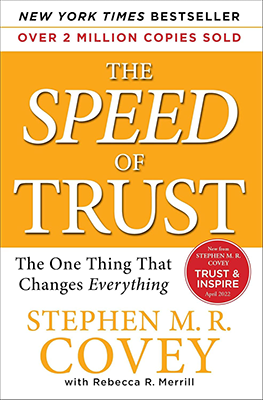
The Speed of Trust
The Speed of Trust
The Speed of Trust by Stephen M.R. Covey explores how trust functions as the key driver of personal and organizational success. Covey argues that trust is not merely a social virtue but a measurable, actionable skill that directly impacts speed, cost, and outcomes. High trust accelerates progress, reduces friction, and fosters collaboration, while low trust slows processes and increases costs. The book introduces the “Five Waves of Trust”: self-trust, relationship trust, organizational trust, market trust, and societal trust, each building upon the other. Covey outlines 13 specific behaviors—such as keeping commitments, delivering results, and demonstrating respect—that leaders and individuals can practice to build and restore trust. He emphasizes that trust is both an economic and cultural advantage, and it can be rebuilt when lost through intentional action. Ultimately, Covey shows that cultivating trust transforms relationships, enhances leadership, and drives sustainable success in both personal and professional spheres.