
Genius of Einstein
Albert Einstein is widely considered one of the greatest scientific thinkers in human history, not only because of what he discovered, but because of how profoundly he changed humanity’s understanding of reality. Einstein’s work reshaped physics, influenced modern technology, and expanded our imagination about time, space, energy, and the structure of the universe. Beyond his scientific breakthroughs, Einstein also offered enduring teachings about curiosity, humility, and the importance of independent thinking. His legacy is both intellectual and philosophical—a reminder that the world becomes clearer when we are willing to question what we assume is “obvious.”
Einstein’s most famous discovery is the theory of relativity, which comes in two parts: special relativity and general relativity. Special relativity revealed that time and space are not fixed and universal in the way people once believed. Instead, time can slow down and lengths can contract depending on how fast an object is moving relative to an observer. This was a radical shift because it overturned the common-sense view that time is the same everywhere. Special relativity also introduced the idea that the speed of light is constant, becoming a foundational principle of modern physics.
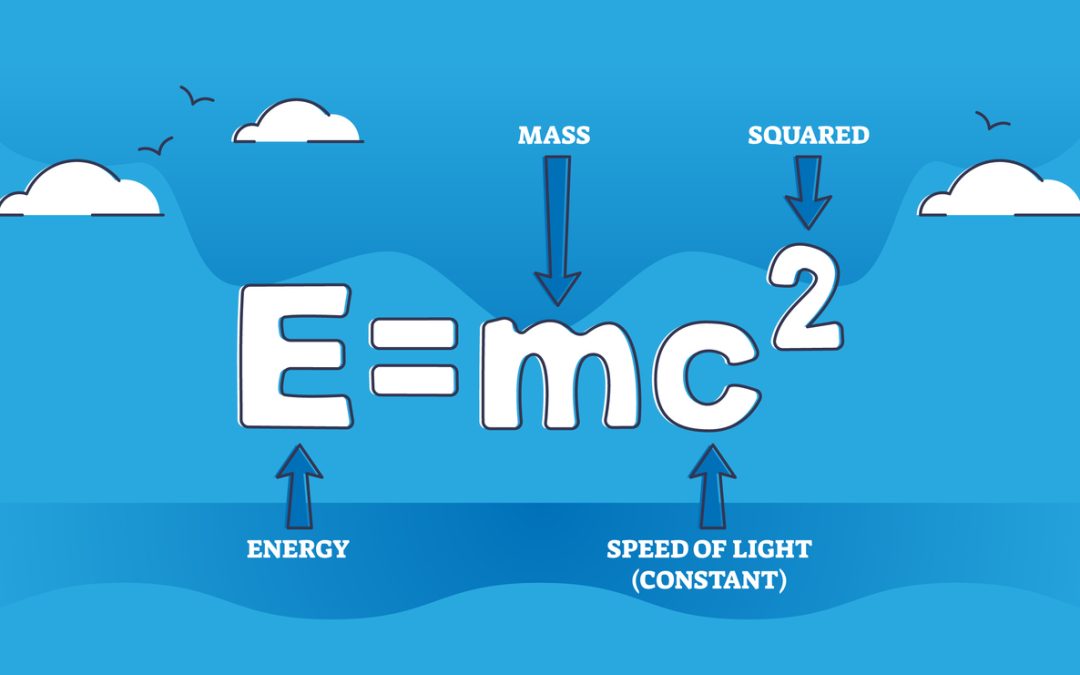
From special relativity came one of the most well-known equations in history: E = mc². This formula expresses that energy and mass are interchangeable—mass is essentially condensed energy. This discovery had enormous implications. It helped explain how stars generate energy and also laid theoretical groundwork for nuclear power. It showed that the universe is far more interconnected than people previously understood: matter is not separate from energy, but another form of it.
Einstein’s second major breakthrough was general relativity, his theory of gravity. Before Einstein, gravity was largely understood through Newton’s laws as a force pulling objects together. Einstein introduced a deeper explanation: gravity is the result of spacetime being curved by mass and energy. In simple terms, large objects like stars and planets “bend” the fabric of spacetime, and other objects move along those curves. This theory explained phenomena that Newton’s physics couldn’t fully account for, such as the orbit of Mercury and the bending of light around massive bodies. Today, general relativity is essential for understanding black holes, gravitational waves, and the structure of the cosmos.
Einstein also made important contributions to quantum physics, even though he famously questioned some of its philosophical implications. One of his key discoveries was the explanation of the photoelectric effect, which showed that light behaves not only as a wave but also as packets of energy called photons. This work helped launch quantum theory and earned him the Nobel Prize in Physics in 1921. The photoelectric effect is also the foundation for technologies like solar panels and light sensors, showing how Einstein’s ideas moved beyond theory into practical impact.
Beyond discoveries, Einstein taught the value of curiosity and wonder. He believed progress comes from asking honest questions, even when the questions seem inconvenient or strange. He modeled the courage to think independently and not submit blindly to authority or tradition. His work reminds us that breakthroughs often come not from complicated thinking alone, but from clear thinking—reducing problems to their essentials and exploring them deeply.
In summary, Einstein’s greatest discoveries—relativity, E = mc², the curvature of spacetime, and the photoelectric effect—helped define modern physics and reshape our understanding of the universe. But his greatest teaching may be his mindset: to stay curious, question assumptions, and pursue truth with humility. Einstein showed the world that reality is far more mysterious and beautiful than it seems, and that human understanding can expand dramatically when we dare to think differently.
Recent Comments