
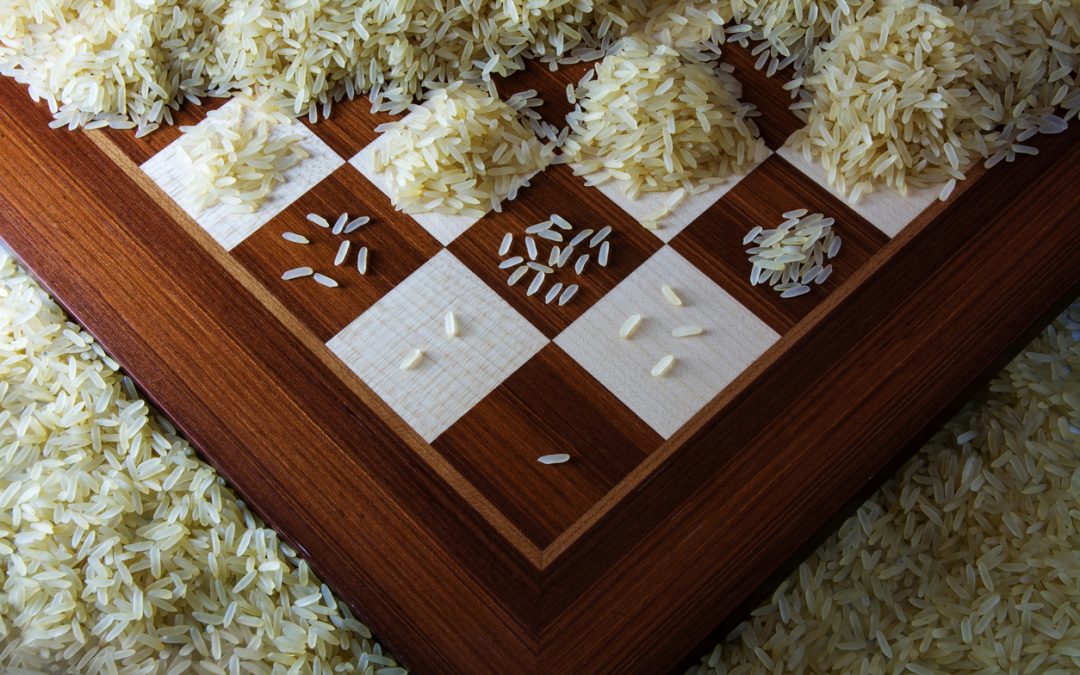
Chess, Rice, and Compounding
The story of the rice and the chessboard is one of the greatest illustrations of exponential growth ever told. It is simple, memorable, and shocking—because it reveals a truth about human nature: we are not wired to intuitively understand how fast exponential growth becomes enormous. The tale varies slightly in its details depending on the version, but the lesson remains the same. What begins as something tiny and unimpressive can become unimaginably large when it doubles repeatedly.
In the classic story, a wise inventor presents a king with the game of chess. The king is impressed and offers the inventor any reward he desires. The inventor asks for what seems like a humble payment: one grain of rice placed on the first square of a chessboard, two grains on the second, four on the third, and so on—doubling the number of grains on each of the 64 squares. The king laughs, thinking the request is trivial. It appears modest, even foolish. But the inventor understands something the king does not: the power of compounding.
The first few squares barely amount to anything. One grain becomes two, then four, then eight. Even after ten squares, the total still looks manageable. This is exactly why exponential growth is so deceptive. In the early stages, it behaves like slow growth. It feels harmless. It appears insignificant. But the doubling continues. By square 20, the numbers begin to feel large. By square 30, they are enormous. And by square 64, the total quantity of rice becomes so massive that it is far beyond what most kingdoms could produce or store. The final outcome is not “a lot of rice.” It is an amount so staggering that it becomes almost impossible to imagine.
This story matters because it exposes a limitation in human thinking. We naturally think in linear terms: if something grows, we expect it to grow steadily, like adding one unit at a time. We are comfortable with predictable progress. But exponential growth does not add—it multiplies. The increase itself grows bigger with every step. The curve remains flat for a while, then suddenly shoots upward. Humans struggle with this because our brains evolved to survive in environments where most change was linear and slow. Exponential growth is not something our ancestors needed to model daily, so we often misjudge it in the modern world.
This misunderstanding shows up everywhere. People underestimate how quickly debt can snowball when interest compounds. They underestimate how powerful consistent saving and investing can become over decades. They underestimate how quickly a small habit—good or bad—can shape a life. They underestimate how fast a business can scale when word-of-mouth or network effects kick in. They underestimate how a small advantage, repeated daily, can create an extreme gap between those who compound and those who don’t.
The rice and chessboard story also offers an important lesson about patience. Compounding rewards those who keep going through the early stages when progress feels slow. Many people quit too soon because they don’t see immediate results. But the early stages are where the foundation is being built. Exponential growth always looks unimpressive before it becomes unstoppable. The person who understands compounding stays consistent, trusting that results will eventually accelerate.
Ultimately, the rice and chessboard story is not just about math—it is about mindset. It teaches that small beginnings can lead to huge outcomes, and that consistent doubling creates extraordinary results. Whether applied to money, health, knowledge, relationships, or business, the lesson is the same: what you repeat grows. Humans may not instinctively understand exponential growth, but we can learn to respect it—and once we do, we begin to realize that the biggest transformations often come from small actions compounded over time.
Recent Comments