
PERT Charts and Critical Paths
PERT charts and critical path thinking are powerful tools for managing complex projects, especially when multiple tasks, dependencies, and uncertain timelines are involved. PERT stands for Program Evaluation and Review Technique, and it was originally developed to help plan and coordinate large-scale projects where delays could be costly. While many project management methods focus on listing tasks, PERT charts go a step further by mapping how tasks connect to one another and showing the sequence that determines the overall project timeline. When used correctly, they bring clarity, structure, and predictability to work that might otherwise feel overwhelming.
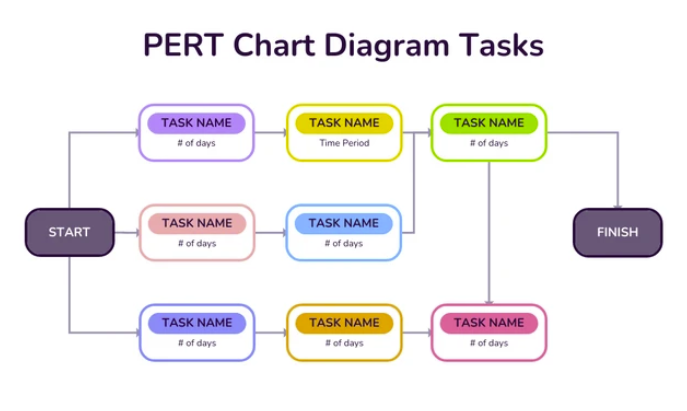
A PERT chart is essentially a network diagram that represents a project as a set of activities linked by dependencies. Each activity is shown as a node or an arrow, and the chart illustrates which tasks must be completed before others can begin. This dependency logic is what makes the PERT chart so valuable. In real projects, many tasks can happen in parallel, while other tasks are bottlenecked behind prerequisites. The PERT chart helps visualize the true flow of work rather than relying on a simple to-do list. It turns project planning into a map instead of a guess.
One of the most important concepts connected to PERT charts is the idea of the critical path. The critical path is the longest sequence of dependent tasks that determines the shortest possible completion time for the entire project. In other words, it is the path through the project where any delay will delay the final delivery date. This is a major insight because it helps leaders focus on what actually controls time. Many people waste effort obsessing over tasks that feel urgent but are not time-sensitive in the bigger picture. Critical path thinking forces a different question: Which tasks are truly driving the timeline? Those tasks deserve the most attention, resources, and risk management.
A key benefit of identifying the critical path is that it reveals where there is “slack” or “float.” Some tasks can be delayed without affecting the project finish date because they are not on the critical path. This slack provides flexibility. It allows teams to shift resources, handle surprises, and adjust priorities without panicking. On the other hand, tasks on the critical path have little or no slack, meaning they must be closely monitored. This helps project managers prevent last-minute emergencies by spotting risks early and protecting the critical sequence of work.
PERT charts are especially useful when time estimates are uncertain. Traditional scheduling can assume a task will take a fixed number of days, but in reality, work often varies. PERT introduces the idea of estimating with ranges—often using optimistic, most likely, and pessimistic time estimates. This is practical because it accepts uncertainty while still allowing a team to plan. It helps managers build realistic timelines and anticipate where variability may cause delays.
In modern business, PERT charts and critical path analysis are useful for product launches, marketing campaigns, construction projects, software development, event planning, and process improvement. Any situation with multiple moving parts can benefit. Even small teams can apply critical path thinking to reduce chaos. It becomes easier to answer questions like: What must happen first? What can happen simultaneously? What is blocking progress? What task is the bottleneck?
Ultimately, PERT charts and the concept of critical paths bring discipline to complexity. They help teams move from reactive scrambling to structured execution. Instead of hoping everything finishes on time, leaders gain visibility into how progress truly works. When teams understand the critical path, they stop wasting energy on distractions and start protecting what matters most: the sequence of work that determines success.
Recent Comments