
Porter's Competitive Strategies
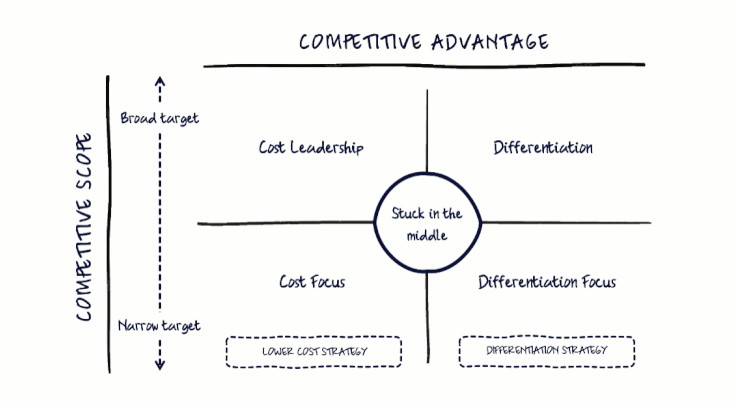
Michael Porter’s three generic strategies—cost leadership, differentiation, and focus—are some of the most influential ideas in modern business strategy. Porter argued that companies must make clear choices about how they will compete, because trying to do everything at once often leads to being “stuck in the middle,” offering no compelling reason for customers to choose you. These strategies provide a practical framework for how businesses can achieve competitive advantage and win in the marketplace. They also offer valuable insight into how individuals can position themselves for success in their careers and personal lives.
The first strategy is cost leadership, sometimes described as being the “least cost” provider. A company that succeeds with cost leadership aims to deliver products or services at the lowest cost in its industry while still maintaining acceptable quality. This allows the business to charge lower prices than competitors or maintain higher profit margins. A classic example is Walmart, which built its model around operational efficiency, high volume, and supply chain mastery to offer “everyday low prices.” Another strong example is Southwest Airlines, which has historically competed by keeping costs low through standardized fleets, efficient operations, and simplified service models. Cost leadership is not about being cheap—it is about being exceptionally efficient so the customer receives more value per dollar.
The second strategy is differentiation, where a business competes by offering something uniquely valuable that customers are willing to pay more for. Differentiation can be based on design, branding, customer experience, technology, innovation, or quality. Apple is one of the best-known examples of differentiation. Apple products often cost more than competitors, but many customers choose them because of sleek design, strong ecosystems, and a reputation for simplicity and premium user experience. Another example is Nike, which differentiates through branding, athlete endorsements, design, and emotional storytelling, selling more than just shoes—it sells identity and aspiration. Differentiation is powerful because it reduces price sensitivity. When customers perceive something as special, they stop comparing purely on cost.
The third strategy is the focus strategy, where a company targets a narrow market segment instead of serving everyone. Focus can take two forms: cost focus (being the low-cost provider in a niche) or differentiation focus (offering specialized value to a niche). A good example is Rolls-Royce, which focuses on a luxury segment rather than mass-market vehicles. Another example is In-N-Out Burger, which focuses on a limited menu and consistent quality rather than expanding into endless options. Smaller companies often succeed through focus because they can serve a specific customer group better than giant competitors trying to serve everyone.
Porter’s strategies also apply beyond business. In life and career, you are constantly competing for opportunities, trust, attention, and influence. You can adopt a “cost leader” approach by being the most efficient, reliable, and productive person in the room—someone who delivers results faster and with fewer resources. You can pursue differentiation by developing rare skills, a distinctive personal brand, or exceptional creativity and leadership. Or you can focus by becoming world-class in a niche, such as being the best marketer in a specific industry, the best designer for a certain style, or the go-to expert in a specialized tool.
Ultimately, the lesson of Porter’s strategies is simple: success comes from choosing your lane. Whether in business or in personal growth, clarity creates power. When you know how you win, you stop chasing everything and start building momentum in the direction that matters most.
Recent Comments