
Maps of Consciousness
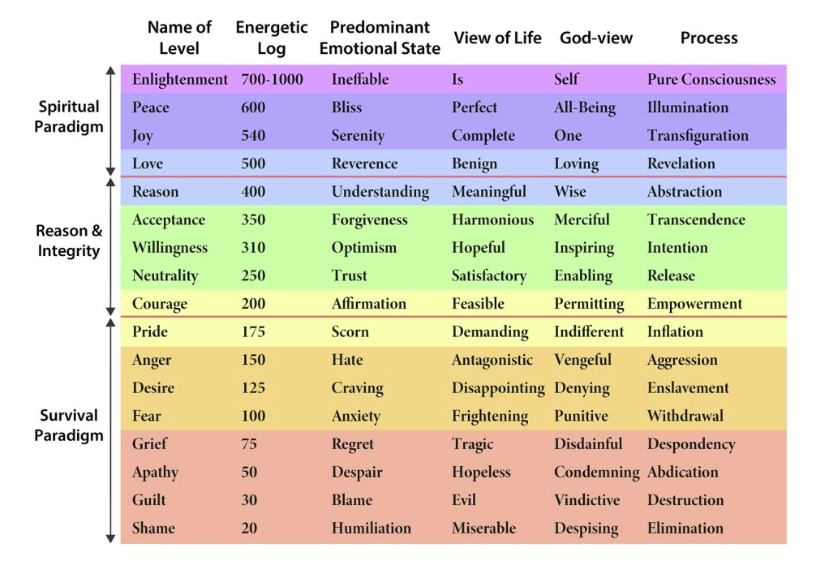
In Power vs. Force, psychiatrist David R. Hawkins presents a provocative model of human development called the “Map of Consciousness.” According to Hawkins, people do not merely differ in personality or intelligence—they differ in the level of consciousness through which they perceive reality. He describes these levels as measurable “vibrational” states, each carrying its own emotional tone, worldview, and pattern of behavior. In this framework, life is not experienced objectively. Instead, each person interprets the world through the lens of their current internal frequency, or vibration.
Hawkins’ model is often shown as a scale ranging from 1 to 1000, with key thresholds that represent major shifts in human awareness. At the lower levels—such as shame, guilt, fear, and grief—people experience life as heavy, threatening, and defeating. Shame produces feelings of worthlessness and the belief that one is fundamentally broken. Fear assumes danger is everywhere, creating anxiety, mistrust, and avoidance. In these states, life feels like something to survive, not something to build. The world seems hostile, and people often blame themselves, others, or fate while feeling trapped inside their circumstances.
As consciousness rises, the emotions and worldview begin to shift. Anger may still be uncomfortable, but Hawkins suggests it can represent a kind of energy—an awakening of strength compared to the paralysis of fear. Pride is higher than anger, offering motivation and confidence, though it can also become defensive or arrogant. The turning point in Hawkins’ map is often described around the level of courage (commonly marked near 200). At this threshold, a person moves from feeling victimized by life to believing they can participate in it. Courage brings empowerment, responsibility, and forward motion. Instead of “life happens to me,” the mindset becomes “I can do something about this.”
Above courage are increasingly constructive states: neutrality, willingness, acceptance, reason, love, joy, and peace. In willingness, people become teachable and open. In acceptance, they stop fighting reality and start working with it. Reason brings clarity and intellectual order, but Hawkins argues that reason alone is not the highest state, because the heart can perceive truths the mind cannot calculate. Higher still is love—not merely romantic love, but an expansive compassion and unity with life. From love, a person tends to see opportunities, meaning, and connection everywhere. Joy and peace reflect an even deeper trust: a sense that life is ultimately coherent, purposeful, and good.
In Hawkins’ view, vibrations become “higher” as a person shifts from contraction to expansion, from fear to truth, and from force to power. “Force” is ego-driven: it pressures, manipulates, and controls. “Power” flows naturally: it inspires, aligns, and strengthens. One might say that lower vibrations demand outcomes, while higher vibrations cooperate with reality. Higher consciousness does not mean life is perfect; it means the person is no longer imprisoned by their reactions.
A key idea in this framework is that people literally see different worlds depending on their level. A fearful person may interpret feedback as rejection. A courageous person interprets it as useful data. A loving person interprets it as a chance to grow and connect. The external event may be the same, but the meaning changes completely—because the observer changes.
Ultimately, Hawkins’ model suggests that personal transformation is not just “self-improvement,” but a shift in consciousness. As vibration rises, perception becomes clearer, reactions become less compulsive, and life becomes less about survival and more about purpose. In that sense, the path upward is not simply becoming “better,” but becoming more awake.
Recent Comments