
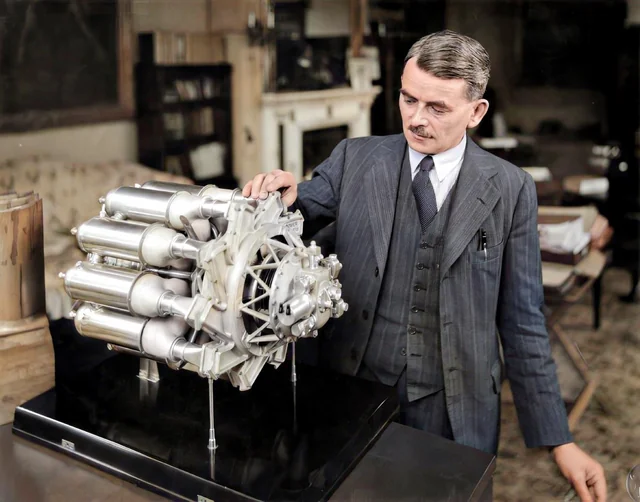
Frank's Jet Engine Didn't Melt!
Frank Whittle’s invention of the jet engine is one of the most striking examples of how transformative ideas are often dismissed before they reshape the world. Whittle was not a famous industrialist or a well-funded researcher when he developed his concept. He was a young British Royal Air Force officer with an idea that challenged conventional thinking about propulsion. His persistence in the face of skepticism—and outright disbelief—ultimately helped usher in the modern age of aviation.
In the late 1920s, aircraft were powered by piston engines driving propellers. These engines worked reasonably well at lower speeds and altitudes, but they had clear limitations. As planes flew faster, propellers lost efficiency, and engine performance declined at high altitude. Whittle recognized that if aircraft were ever to fly significantly faster and higher, they would need a completely different approach. While still a cadet, he conceived of an engine that would compress air, mix it with fuel, ignite it, and use the resulting high-speed exhaust to generate thrust directly—a jet engine.
The idea was radical, and Whittle encountered resistance almost immediately. When he presented his concept to superiors, he was told it would never work. One of the most common objections was that the engine would become too hot and simply melt. Critics believed the materials available at the time could not withstand the temperatures generated by continuous combustion. Others argued that the design was impractical, inefficient, or unnecessary. Whittle’s ideas were often shelved, ignored, or underfunded, even after he patented the jet engine in 1930.
Despite this skepticism, Whittle persisted. He understood that the physics were sound, even if the engineering challenges were significant. Advances in metallurgy, cooling, and turbine design would be required, but none of these obstacles were insurmountable. Working with limited resources and facing constant bureaucratic resistance, Whittle eventually built a functioning prototype. In 1937, his jet engine ran successfully on the ground. By 1941, a jet-powered aircraft using his engine flew for the first time.
Although Britain was slow to fully capitalize on Whittle’s invention during World War II, the jet engine proved its value quickly. Jet-powered aircraft could fly faster, higher, and farther than piston-driven planes. After the war, jet technology spread rapidly, reshaping both military and civilian aviation. What had once been dismissed as impractical became the standard.
The impact of the jet engine on the world has been profound. Commercial jet travel shrank the planet. Journeys that once took days or weeks by ship could now be completed in hours. Global business expanded. Tourism exploded. Families became more connected across continents. Cultures mixed more easily. The jet engine helped accelerate globalization by making long-distance travel routine rather than exceptional.
Militarily, jets changed the nature of warfare. Speed and altitude altered air combat, reconnaissance, and strategic reach. Nations with advanced jet technology gained significant advantages, influencing geopolitics and defense strategies for decades.
Frank Whittle’s story is a reminder that innovation often looks impossible before it becomes inevitable. His boss’s warning that the engine would melt was not foolish—it reflected the limits of existing knowledge and materials. But Whittle saw beyond those limits. He understood that progress often requires betting on what is theoretically possible, even when practical details lag behind.
In the end, Whittle’s jet engine did not melt. Instead, it melted away old assumptions about flight and opened the sky to a new era. His legacy is not just an invention, but a lesson: revolutionary ideas often arrive early, face resistance, and change the world anyway.
Recent Comments