
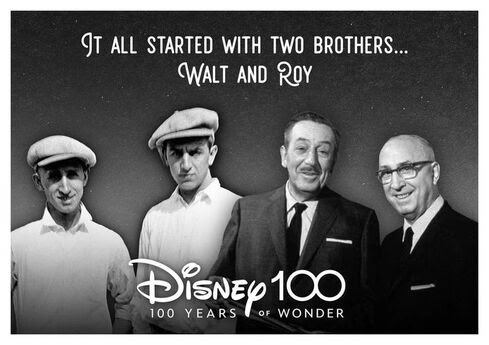
Walt and Roy
Walt Disney and his older brother Roy Disney together built one of the most influential entertainment companies in history, but their success came only after years of failure, financial stress, and persistence. Their partnership worked precisely because the brothers were opposites: Walt was the visionary dreamer, while Roy was the disciplined realist. Alone, neither would likely have succeeded at the scale they did. Together, they created a legacy that reshaped storytelling, animation, and popular culture.
Walter Elias Disney was born in 1901 in Chicago and grew up in a family that struggled financially. From a young age, Walt showed a passion for drawing and storytelling. As a young adult, he pursued animation with enthusiasm but little business experience. His first major venture, Laugh-O-Gram Studio in Kansas City, collapsed into bankruptcy. Walt was broke, discouraged, and nearly out of options. In 1923, he moved to Hollywood with little more than a suitcase, a reel of unfinished cartoons, and a stubborn belief that animation could become something greater.
Roy O. Disney, born in 1893, was nearly a decade older than Walt and far more practical. He had a background in banking and finance and was cautious by nature. When Walt called on Roy to help fund another animation studio, Roy agreed—but with strict oversight. Roy handled finances, contracts, and negotiations, while Walt focused on creative direction. This division of labor became the foundation of their success.
The early years were precarious. The brothers lost the rights to one of Walt’s early characters, Oswald the Lucky Rabbit, a crushing blow that nearly ended the company. Out of that setback came Mickey Mouse, created in 1928. Mickey’s success brought stability, but cash flow remained a constant challenge. Walt pushed boundaries artistically, investing heavily in sound, color, and feature-length animation. Roy often worried about costs and debt, but he found ways to finance Walt’s ambitions without letting the company collapse.
Their most dramatic risk came with Snow White and the Seven Dwarfs in 1937, the first full-length animated feature film. Many in Hollywood mocked it as “Disney’s Folly,” predicting audiences wouldn’t sit through a cartoon that long. Roy struggled to secure financing and personally negotiated loans to keep the project alive. When the film became a massive success, it validated Walt’s creative instincts and Roy’s financial discipline.
As the company expanded into theme parks, the pattern continued. Walt imagined Disneyland as a living storybook, something no one had attempted before. Roy worried about spiraling costs and logistical nightmares, but once again found ways to fund and execute the vision. Disneyland opened in 1955 and became a cultural landmark.
Walt Disney died in 1966, before seeing his most ambitious dream realized: Walt Disney World. Roy, despite being ready to retire, postponed retirement to finish what his brother started. He oversaw the completion of Walt Disney World in Florida, ensuring it honored Walt’s vision. Roy died in 1971, shortly after the park opened.
The story of Walt and Roy Disney is not just about creativity or business—it is about partnership. Walt imagined worlds that didn’t exist. Roy made them sustainable. Their success came not from avoiding conflict, but from balancing vision with discipline. Together, they proved that dreams need structure to survive, and that enduring greatness is often built by two very different minds working toward the same purpose.
Recent Comments