
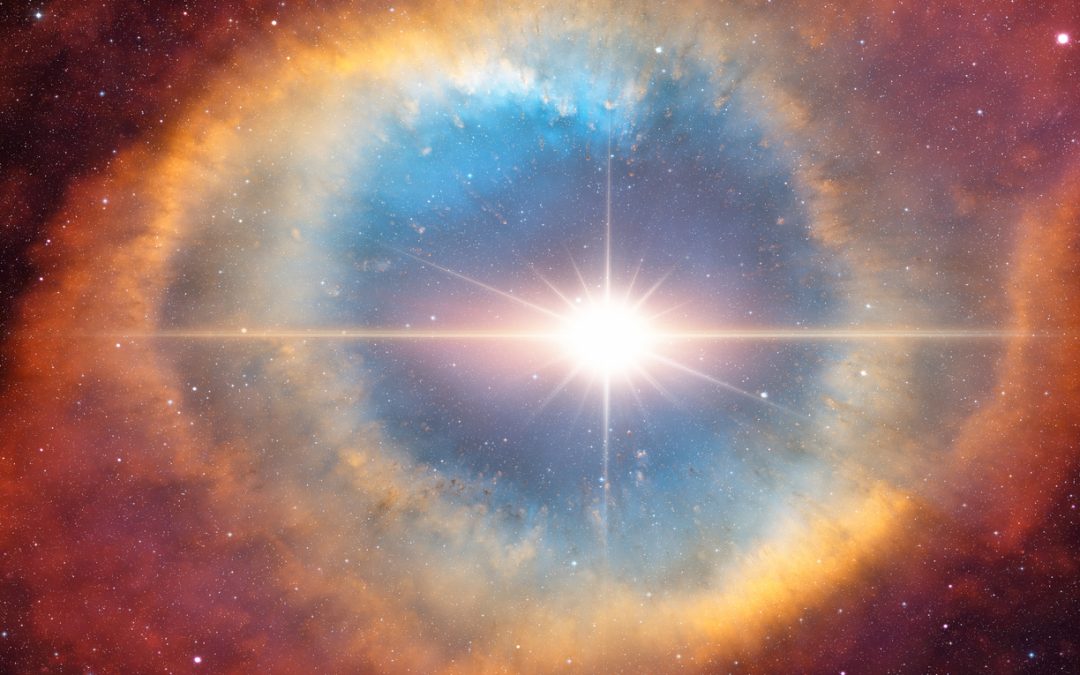
A Photon's Perspective
Perspective shapes reality more profoundly than we often realize. The same event can appear vast or fleeting, monumental or insignificant, depending entirely on the vantage point from which it is observed. Modern science offers one of the most striking illustrations of this truth. Cosmologists tell us that the universe is over 13 billion years old—a span of time so immense that it dwarfs the entirety of human history. Yet Einstein’s theory of relativity reveals something astonishing: for a photon traveling at the speed of light, the journey across billions of years is experienced as an instant. The same event—light traveling across the cosmos—contains both unimaginable duration and no duration at all. Perspective determines the meaning of time itself.
From our human standpoint, time feels steady and absolute. We measure it in seconds, years, and millennia. We speak of ancient stars whose light began traveling toward Earth long before life emerged here. When we gaze at the night sky, we are literally looking back in time. The light entering our eyes may have departed its source millions or even billions of years ago. To us, that journey is almost incomprehensibly long.
But relativity unsettles this intuition. As an object approaches the speed of light, time slows relative to stationary observers. For a photon—if we can even meaningfully speak of its “experience”—time does not pass. The emission of the photon from a distant star and its absorption by your eye are separated by billions of years in our frame of reference, yet from the photon’s perspective, they are adjacent events. The vast cosmic gulf collapses into immediacy.
This scientific insight carries philosophical weight. It reminds us that what feels absolute may, in fact, be relative to our position. Duration, distance, even simultaneity depend on the observer. If something as fundamental as time bends according to perspective, how much more flexible might our everyday interpretations be?
Consider conflicts between individuals or cultures. Each party inhabits a particular frame of reference shaped by history, environment, and experience. Within that frame, their conclusions may feel as solid and objective as the ticking of a clock. Yet another observer, standing in a different context, may perceive the same situation entirely differently. Just as physics teaches that no single inertial frame holds a monopoly on “true” time, human experience suggests that no single viewpoint exhausts truth.
Perspective also alters our sense of significance. In the context of a 13-billion-year universe, a human lifespan appears vanishingly brief. Civilizations rise and fall in what amounts to a cosmic heartbeat. This awareness can inspire humility, even awe. At the same time, from within the span of a single life, moments stretch wide with meaning. A conversation, a decision, a loss—these can feel immense. Neither view is wrong. Each is true within its scale.
The photon’s journey teaches us that reality is layered. The universe can be both ancient and immediate, expansive and intimate. Understanding depends on where we stand. When we acknowledge this, we become less rigid in our judgments and more curious about alternative frames. We begin to ask not only “What is true?” but also “From whose perspective?”
In science and in life, growth often begins with this shift. By stepping outside our habitual vantage point—even briefly—we discover that the world is richer and more complex than it first appears. Perspective does not merely color reality; it helps create the dimensions through which reality is understood.
Recent Comments