
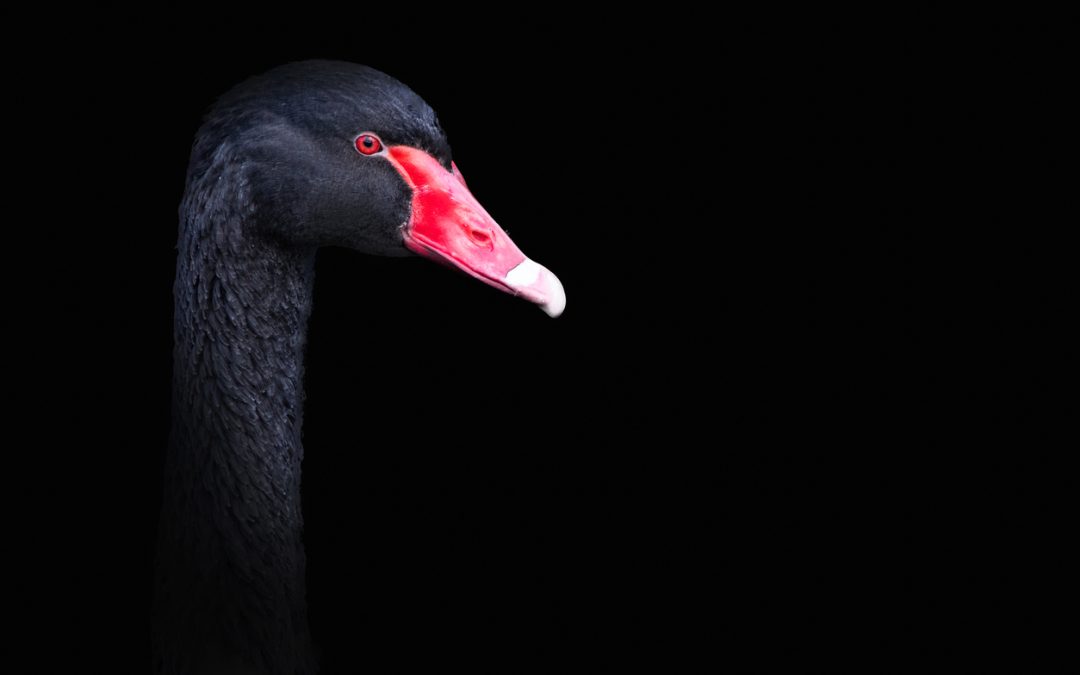
Learn From the Black Swan
Black swan events are the rare, high-impact shocks that reshape history and scramble our sense of how the world works. The term—popularized by Nassim Nicholas Taleb—refers to events that are difficult to predict in advance, carry massive consequences, and are often explained after the fact as if they were inevitable. What makes a black swan so disturbing isn’t only the damage it causes; it’s the way it exposes the limits of our forecasting, our institutions, and our confidence. Black swans remind us that the world is not as controllable as we’d like to believe.
History offers dramatic examples. The meteor impact that contributed to the extinction of the dinosaurs is the ultimate black swan: a sudden, catastrophic event that radically altered life on Earth. Human history has its own: the Great Depression devastated economies and families worldwide, fundamentally changing views on markets and government intervention. The September 11 terrorist attacks shocked the United States and the world, redefining security, geopolitics, and public consciousness. The Lehman Brothers collapse and the subsequent housing crisis cascaded through global financial systems, wiping out wealth, destabilizing governments, and altering how we think about risk. In each case, most people did not see the event coming in its full form or magnitude. Even those who sensed vulnerabilities rarely predicted the exact trigger, timing, or chain reaction.
Black swan events feel like they come out of nowhere because they often emerge from complex systems—financial markets, ecosystems, global politics—where countless variables interact. In such systems, small changes can build silently until a tipping point is reached. The structure looks stable, right up until it fails. When the failure arrives, it feels sudden, but the conditions for it may have been accumulating beneath the surface. This is part of what makes black swans so challenging: they are not always purely random, yet they evade normal prediction because our models focus on what is typical, not what is extreme.
Because these events are so disruptive, it’s tempting to respond with fear. If catastrophe can strike at any moment, why take risks? Why trust institutions? Why plan? But living in fear of black swans is its own kind of disaster—one that shrinks our lives and paralyzes our choices. A world without uncertainty is not available to us, so the better goal is resilience: the capacity to absorb shocks, adapt, and recover. We cannot eliminate black swans, but we can build lives and systems that aren’t fragile when they arrive.
This is where the right lessons matter. The wrong lesson is to obsess over predicting the next black swan with perfect accuracy. That pursuit often creates false confidence, and it encourages “fortune-telling” rather than preparedness. The right lesson is simpler and more honest: stuff happens. Reality does not always respect our plans. The unexpected is not a rare glitch—it is part of the design of life. Accepting that truth is not pessimism; it is maturity.
From that foundation, growth becomes possible. Individuals can diversify their skills and income sources, maintain savings, invest in strong relationships, and cultivate mental flexibility—so that when disruption hits, they have options. Organizations can avoid over-optimizing for efficiency at the expense of adaptability, build buffers, conduct scenario planning, and encourage transparent risk discussions instead of suppressing bad news. Governments and societies can strengthen public health systems, reinforce infrastructure, and maintain safeguards for vulnerable populations. These steps don’t require predicting the next shock; they require admitting that shocks will come.
Perhaps the most powerful lesson black swans offer is humility. They teach us that control is often an illusion and that certainty can be a dangerous comfort. But they also teach us courage: even in a world where meteors, depressions, terrorist attacks, and financial collapses can strike, people rebuild. Communities reorganize. Innovations emerge. The human story is not only one of catastrophe, but also of recovery. Black swan events remind us that while we can’t stop every storm, we can become the kind of people—and build the kind of systems—that learn, adapt, and grow stronger because we faced one.
Recent Comments