
Big 5 Personality Framework
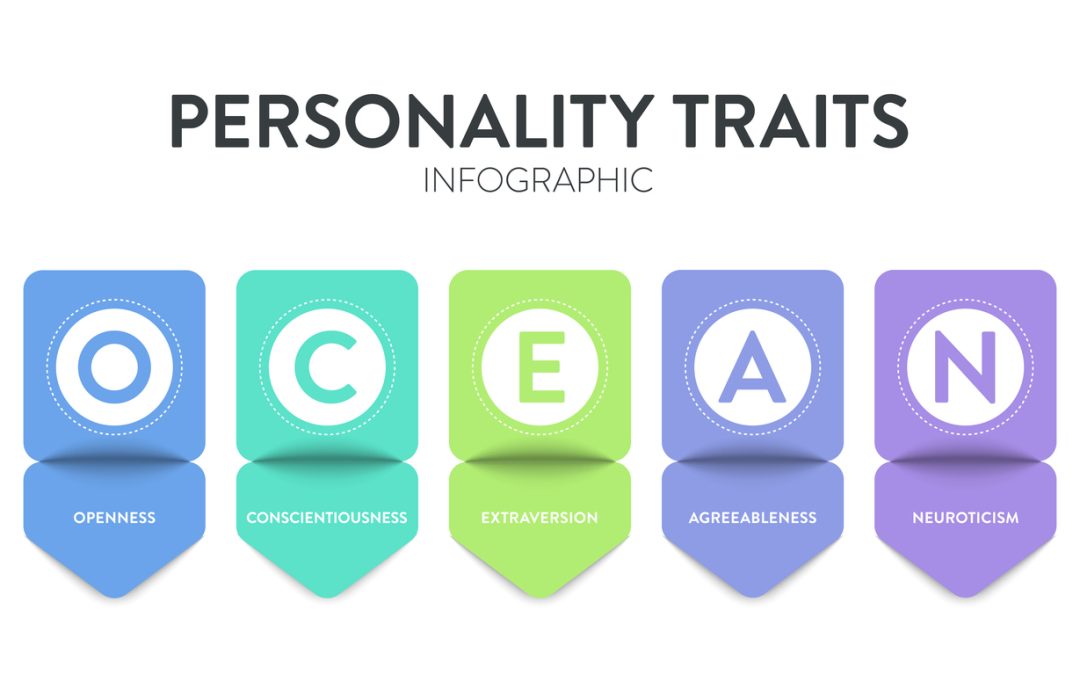
The Big Five personality framework, often remembered by the acronym OCEAN—Openness, Conscientiousness, Extraversion, Agreeableness, and Neuroticism—is one of the most widely accepted models of human personality in modern psychology. Rather than placing people into rigid categories, the Big Five describes personality as a set of continuous traits. Each person falls somewhere along a spectrum for each trait, creating a nuanced profile rather than a fixed “type.”
The origins of the Big Five can be traced to early twentieth-century efforts to identify the fundamental dimensions of personality. Psychologists were influenced by the lexical hypothesis, the idea that the most important personality differences become encoded in language over time. In the 1930s, researchers such as Gordon Allport and Henry Odbert combed through dictionaries, identifying thousands of words that described human traits. Later, in the 1940s and 1950s, Raymond Cattell used statistical techniques, particularly factor analysis, to reduce these terms into smaller clusters of traits. Although Cattell proposed sixteen primary factors, subsequent researchers continued refining the structure.
In the 1960s, Ernest Tupes and Raymond Christal reanalyzed earlier data and consistently found five broad factors. Their work went largely unnoticed at first, but in the 1980s, psychologists Paul Costa and Robert McCrae further developed and validated the five-factor model through extensive research. Since then, the Big Five has become a dominant framework in personality psychology, supported by decades of cross-cultural studies demonstrating its reliability and stability.
Each of the five dimensions captures a central aspect of personality. Openness to Experience reflects imagination, curiosity, and a willingness to entertain new ideas. Individuals high in openness tend to appreciate art, creativity, and intellectual exploration, while those lower in openness may prefer familiarity and practicality.
Conscientiousness describes self-discipline, organization, and goal-directed behavior. Highly conscientious individuals are often reliable, careful, and achievement-oriented. Lower levels may be associated with spontaneity but also with disorganization or difficulty following through on plans.
Extraversion measures sociability, assertiveness, and energy derived from social interaction. Extraverts often enjoy being around others and seek stimulation, whereas introverts may prefer solitary activities or smaller, quieter settings. Importantly, introversion is not the same as shyness; it reflects where someone gains or expends energy.
Agreeableness captures traits related to compassion, cooperation, and trust. People high in agreeableness tend to be empathetic and considerate, while those lower on the scale may be more competitive, skeptical, or blunt in their interactions.
Neuroticism refers to emotional stability and the tendency to experience negative emotions such as anxiety, sadness, or irritability. Higher levels indicate greater emotional reactivity and vulnerability to stress, while lower levels suggest calmness and resilience.
One of the strengths of the Big Five model is its empirical foundation. Unlike personality systems rooted in typology or anecdote, OCEAN emerged from statistical analysis of language and behavior. It has proven useful in predicting outcomes such as job performance, relationship satisfaction, health behaviors, and even life expectancy.
However, the model is descriptive rather than explanatory. It outlines what personality traits exist but does not fully explain why they develop or how they interact with environment and culture. Even so, the Big Five remains a cornerstone of contemporary psychology, offering a flexible, research-based framework for understanding the complexity of human personality.
Recent Comments