
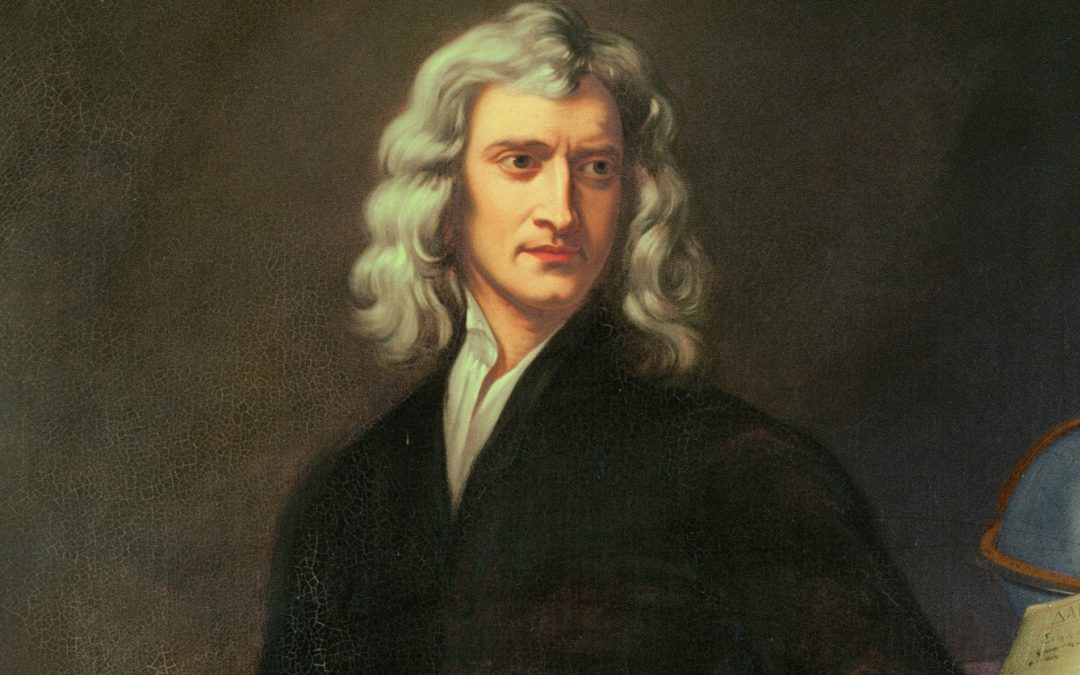
Greatest Mind in History
Isaac Newton is widely regarded as one of the greatest scientific minds in human history. His discoveries did not merely add new information to the world—they changed the way humanity understood reality itself. Newton’s best teachings and breakthroughs shaped modern physics, mathematics, astronomy, and engineering, and they helped launch the scientific revolution into a new era of precision and prediction. More than a brilliant thinker, Newton also embodied a powerful lesson: that nature can be understood through disciplined observation, logical reasoning, and mathematical structure.
Newton’s most famous discovery is the law of universal gravitation. Before Newton, gravity was not understood as a universal force operating the same way everywhere. Newton proposed that every object in the universe attracts every other object, and that this attraction depends on mass and distance. This single idea unified the motion of objects on Earth with the movement of planets in space. It explained why apples fall, why the Moon orbits Earth, and why the planets orbit the Sun. Gravity became not just a mystery, but a measurable law. This transformed astronomy from descriptive observation into a predictive science.
Closely connected to gravity are Newton’s three laws of motion, which remain foundational to physics today. The first law states that an object in motion stays in motion, and an object at rest stays at rest unless acted upon by an external force. The second law explains how force relates to mass and acceleration, forming the basis of how we calculate motion and energy. The third law—“for every action there is an equal and opposite reaction”—reveals a symmetry in physical interactions that is still used to understand everything from walking to rocket propulsion. These laws introduced a structured, mechanical understanding of the physical world and allowed engineers and scientists to design systems with predictable outcomes.
Newton’s influence also extends deeply into mathematics. One of his greatest achievements was the development of calculus (developed independently around the same time by Gottfried Wilhelm Leibniz). Calculus gave humanity a new tool to measure change and motion in a precise way. With calculus, Newton could describe how velocity changes, how forces accumulate, and how curves behave. The invention of calculus became essential to nearly every modern field of science and engineering—physics, economics, medicine, computer science, and even artificial intelligence. It provided the language needed to describe dynamic systems.
Another major area of Newton’s discovery was optics. He studied the nature of light and demonstrated that white light is not a pure substance but a combination of colors. Using prisms, Newton showed that light can be separated into a spectrum, laying the groundwork for the scientific understanding of color. He also built the first practical reflecting telescope, which used mirrors instead of lenses and improved clarity. His work in optics advanced both scientific theory and technology.
Beyond the technical discoveries, Newton’s greatest teaching may be the example he set for how knowledge is built. He showed that the universe is not random chaos but governed by laws that can be discovered. He modeled careful experimentation, disciplined thinking, and the willingness to challenge old assumptions. Newton’s success came not from luck, but from relentless focus and a deep curiosity about how the world truly works.
In summary, Isaac Newton’s best discoveries—gravity, the laws of motion, calculus, and optics—became pillars of modern science. His work gave humanity the power to predict the movement of planets, design machines, understand light, and calculate change. Newton’s legacy is not only what he discovered, but the mindset he demonstrated: that with rigorous reasoning and persistence, the hidden patterns of nature can be revealed.
Recent Comments