
Which VALS Are You?
SRI’s VALS (Values and Lifestyles) framework is a well-known psychographic market segmentation system designed to explain why consumers make the choices they do. Developed by SRI International, VALS segments people based not only on demographics (age, income, etc.) but primarily on the psychological drivers that shape purchasing behavior. The model is grounded in the idea that consumers’ buying decisions are influenced by a combination of their core motivations and the resources they have available to act on those motivations.
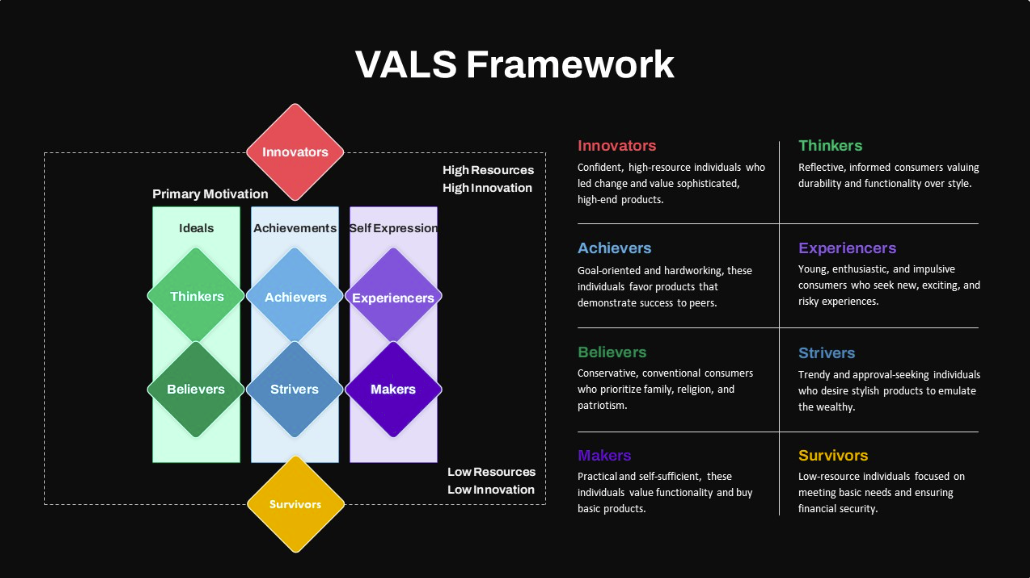
At the heart of VALS are three primary motivations—the inner drivers that influence what individuals value most. These motivations are commonly described as: Ideals, Achievement, and Self-Expression.
-
Ideals-motivated consumers are guided by principles, knowledge, and beliefs. They seek functionality, reliability, and products that align with their worldview.
-
Achievement-motivated consumers are driven by goals, status, and recognition. They respond well to brands that signal success, prestige, or professional accomplishment.
-
Self-expression-motivated consumers prioritize experiences, variety, risk-taking, and individuality. They are drawn to products that reflect personality, creativity, or adventurousness.
The second key dimension in VALS is resources, which represent an individual’s capacity to pursue their motivations. Resources include factors such as income, education, self-confidence, energy level, and access to information. People with higher resources tend to be more open to innovation and change, while those with fewer resources may prioritize affordability, security, or familiarity.
VALS combines these dimensions into eight consumer segments, typically displayed as a diagram with resources ranging from high to low. At the top are individuals with the greatest resources, who tend to be more sophisticated and influential in markets. At the bottom are those with the fewest resources, who may have more constrained purchasing behavior.
The eight segments are: Innovators, Thinkers, Achievers, Experiencers, Believers, Strivers, Makers, and Survivors.
-
Innovators are affluent, confident, and open to new ideas; they often adopt products early and influence others.
-
Thinkers are reflective, informed, and value durability and practicality.
-
Achievers are goal-oriented and brand-conscious, purchasing products that reinforce status and success.
-
Experiencers are young, enthusiastic, and driven by novelty and excitement.
-
Believers are traditional, community-oriented, and loyal to familiar brands.
-
Strivers want achievement and style but may lack the resources to fully realize those aspirations.
-
Makers are practical and hands-on, preferring functional goods and self-sufficiency.
-
Survivors are the most resource-constrained and tend to be cautious, focusing on safety, value, and essentials.
In practice, VALS helps marketers tailor messaging, product design, and channel strategy by aligning brand positioning with the psychological needs of each segment. Its value lies in shifting segmentation from “who the customer is” to “why they buy,” enabling deeper understanding of consumer behavior and more resonant marketing strategies.
Recent Comments